



Data Centers
Large-scale data centers are a new and potentially impactful use that has surfaced in our region recently and has gained nationwide attention as artificial intelligence grows in its capabilities and use. Some municipal ordinances may not adequately address the unique characteristics of this type of development. Municipalities should identify areas in their community that might have suitable infrastructure for data center development and proactively adopt clear ordinance language to adequately regulate this use.
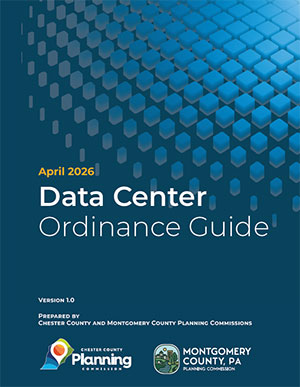
Data Center Ordinance Guide
To support municipalities in understanding, planning for, and regulating this evolving land use, we developed a new Data Center Ordinance Guide, in conjunction with our partners at the Montgomery County Planning Commission. The guide provides two important tools for municipalities — factual information about data centers' land use impacts based on current knowledge and research from many partners through PA, and model ordinance language for local regulation. View the guide.
Overview
Data center locational needs
- Within 1-2 miles of high-voltage electric transmission lines
- Near major fiber optic lines
- Within or near a public water service area
- Typically require a tract of 75 acres or more
Power usage
Data centers recently proposed in the region would consume over 1 gigawatt (GW) of power or more if constructed — roughly equivalent to a medium city's energy use. Power may come from the electric grid or on-site generation — most likely natural gas turbines. Municipalities should consider adopting regulations for power generation facilities and should decide whether to permit two principal uses (power generation facilities and data centers) on a single tract.
Examples of Ordinances Regulating Power Generation:
- Newport Township, Luzerne County regulates Gas-Fired Electric Generating Facilities. Section 528 of the ordinance considers large-scale, impactful generating facilities and requires developers to submit a Site Compatibility and Infrastructure Impact Review, as well as an extensive Full Impact Assessment. It includes setbacks, height limits, impervious coverage limits, and standards for sound and decommissioning.
- West Nantmeal Township, Chester County regulates Alternative and Emerging Energy Facilities. The ordinance is structured to regulate private generation facilities that will power an on-site principal use. While it focuses on renewable energy sources that may be unlikely to be developed on the same site as a data center in our region, the ordinance framework may be helpful to municipalities looking to regulate on-site private energy generation facilities.
Water usage
Data center equipment must be cooled using either air or water. Air cooling can be noisy due to large fans, while water cooling can consume significant volumes of water — potentially millions of gallons per day during summer months. Public water connections are often required and could necessitate upgrades to treatment infrastructure. In these cases, public water providers would need to obtain approval from the Delaware or Susquehanna River Basin Commission for new water withdrawals over 100,000 gallons/day.
Noise
Cooling systems and backup generators can produce continuous noise, including low-frequency vibrations, which may be more noticeable at night when background noise is reduced. Municipal noise ordinances may not fully address data center noise as written.
Air quality
Facilities with on-site power generation may raise air quality concerns. Backup fossil-fuel generators are tested regularly, though total operation typically amounts to only a few hours per year. Data centers may be required to obtain air quality permits from PA DEP due to backup generator use.
Economic impact
Data centers generate fewer jobs per square foot than many other industrial uses, though these positions are often higher-paying. Construction is typically phased, resulting in longer-term construction employment. Data centers also contribute tax revenue to local municipalities primarily through property taxes. State taxes include corporate income tax, although PA exempts many types of data center equipment from sales and use tax for qualifying data centers, similar to nearly 3 dozen other states. Additionally, data center employees would pay earned income taxes to local municipalities and the state.
Further Reading
The following resources will provide municipalities with an understanding of how data centers work, their unique needs, and their potential impacts and benefits. Several model ordinances have been developed that municipalities can use as reference when developing their own codes. The Planning Commission will continue to expand information and resources on this webpage as it becomes available.
Guidance Documents
- Cumberland County Data Center Fact Sheet
- Diesel Generators at Data Centers report from the Better Data Center Project
- DVRPC: Understanding Data Centers Guide
- Georgetown Climate Center's Local Ordinances to Help Bring Data Centers into Alignment with Climate Goals
- Lancaster County Planning Commission: A Planning Guide Pertaining to Data Centers Updated May 2026
- Lincoln Institute of Land Policy's Developing a Data Center Policy: A Guide for Communities Navigating AI and Digital Infrastructure
- Urban Land Institute's Local Guidelines for Data Center Development
Model Ordinances
- Penn Future Model Data Center Ordinance
- Southeastern PA Chapter of the Sierra Club's model ordinance
- York County Model Data Center Ordinance
Data Center Mapping
- National Lab of the Rockies' Speed to Power Map
- Pennsylvania Data Center Proposal Tracker
- Existing and Proposed Data Center Mapping